Kojiki, Part 1 · story 14 of 17
The Descent of the Heavenly Grandson
天孫降臨
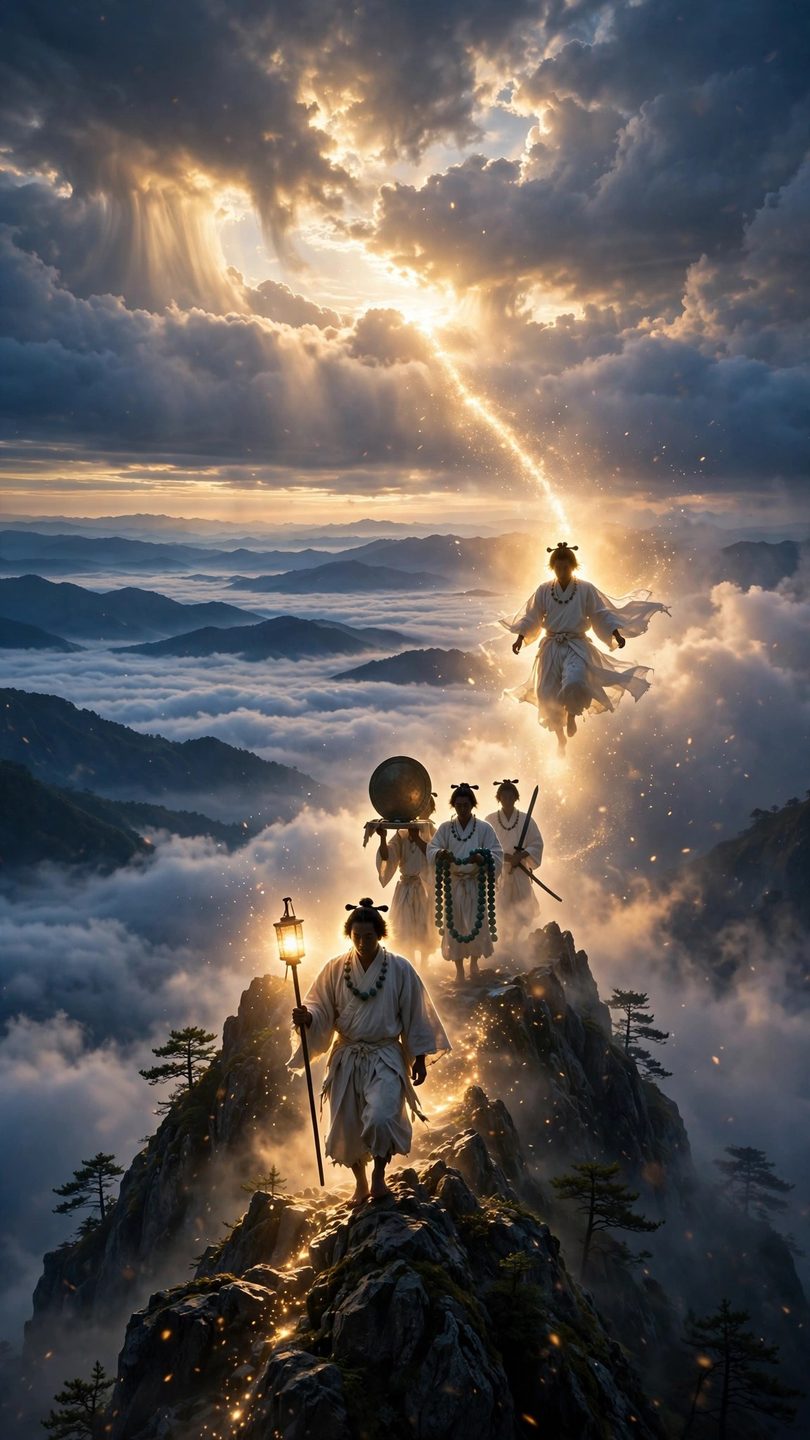
Once the Central Land of the Reed Plains had been pacified, Ninigi-no-Mikoto, son of Ame-no-Oshihomimi-no-Mikoto, went down in his father's place. Guided by Sarutahiko-no-Kami and accompanied by the deities of the five attendant groups (五伴緒), and having received the curved jewels, the mirror and the sword, he descended to Takachiho in Hyūga in Tsukushi. Afterwards Ame-no-Uzume-no-Mikoto escorted Sarutahiko-no-Kami home, took on his name, and became the origin of the Sarume no Kimi (猿女君).
The story
The command to rule given to Ninigi-no-Mikoto
Having received the report of pacification, Amaterasu-Ōmikami and 高木神* commanded the crown prince Ame-no-Oshihomimi-no-Mikoto to go down to the earth and rule it. Ame-no-Oshihomimi-no-Mikoto answered, “While I was making ready to go down, a child was born. This child should be sent down.” This child was the younger of the two born to Ame-no-Oshihomimi-no-Mikoto and Yorozuhata-toyoakitsushi-hime-no-Mikoto (万幡豊秋津師比売命), daughter of 高木神; the elder was Ame-no-Hoakari-no-Mikoto (天火明命). Thus the command to rule the Land of Abundant Reed Plains and Fresh Rice Ears was given to 日子番能邇邇芸命 (Ninigi-no-Mikoto).
Sarutahiko-no-Kami at the Eightfold Crossroads of Heaven
When Ninigi-no-Mikoto was about to come down from heaven, at the Eightfold Crossroads of Heaven (天八衢; a place where roads divide) there was a deity who shone above on Takamanohara and below on the Central Land of the Reed Plains. Amaterasu-Ōmikami and 高木神* commanded Ame-no-Uzume-no-Kami: “Though you are a delicate woman, you are a deity who wins a staring contest against any deity you face, so go and question him.” That deity answered, “I am an earthly deity, and my name is Sarutahiko-no-Kami. I heard that the child of the heavenly deities was coming down, so I have come to meet him, to serve as his guide.”
The five attendant groups, the jewels, the mirror and the sword
The five attendant groups (五伴緒), Ame-no-Koyane-no-Mikoto, Futodama-no-Mikoto (布刀玉命), Ame-no-Uzume-no-Mikoto, Ishikoridome-no-Mikoto (伊斯許理度売命) and Tamanooya-no-Mikoto, were assigned to Ninigi-no-Mikoto. In addition, the eight-shaku curved jewels (八尺勾玉), the mirror and the Kusanagi sword (草那芸剣) were added, along with Tokoyo-no-Omoikane-no-Kami (常世思金神), Tajikarao-no-Kami (手力男神) and Ame-no-Iwatowake-no-Kami (天石門別神). Amaterasu-Ōmikami commanded, “Worship this mirror as my spirit, just as you would worship me. Omoikane-no-Kami, take charge of the affairs of the worship and carry them out.” It is recorded that these two deities were worshipped at “佐久久斯侶,伊須受能宫”. Toyouke-no-Kami (登由宇気神) is regarded as the deity dwelling at 度相* of the Outer Shrine, Ame-no-Iwatowake-no-Kami (天石戸別神) as a deity of the gates, and Tajikarao-no-Kami as the deity dwelling at 佐那那県*; the five attendant groups are regarded as the ancestors of the Nakatomi no Muraji (中臣連), the 忌部首*, the Sarume no Kimi (猿女君), the 作鏡連* and the Tamanooya no Muraji (玉祖連), respectively.
The descent to Takachiho
Ninigi-no-Mikoto left the heavenly rock seat (天石位), pushed apart the many-layered clouds, passed by way of the Floating Bridge of Heaven, and descended to 久士布流多気* at Takachiho in Hyūga in Tsukushi. Ame-no-Oshihi-no-Mikoto and Amatsukume-no-Mikoto, carrying stone quivers on their backs, wearing mallet-headed swords (頭椎大刀) and holding bows and arrows, went at the front and served him. The two are regarded as the ancestors of the Ōtomo no Muraji (大伴連) and the Kume no Atai (久米直), respectively. Ninigi-no-Mikoto said that this land faces 韓国*, leads straight to the cape of 笠紗*, and is a land where the morning sun shines straight and the evening sun shines bright, and so it is a very good land; and he dwelt in a palace with thick pillars set on the bedrock deep in the earth and crossed roof-beams (氷椽) soaring high enough to reach Takamanohara.
Escorting Sarutahiko-no-Kami
Ninigi-no-Mikoto commanded Ame-no-Uzume-no-Mikoto: “You who revealed the identity of Sarutahiko-no-Ōkami, who guided me, shall escort him home, take on that deity's name and serve.” It is said that this is why the Sarume no Kimi bear the name of the male deity Sarutahiko and their women are called Sarume no Kimi. While Sarutahiko-no-Kami was at 阿耶訶*, he was fishing when his hand was caught by a 比良夫 shellfish*, and he sank into the sea and drowned. His name when he sank to the bottom is Sokodoku-mitama (底度久御魂), his name when the sea water rose in bubbles is Tsubutatsu-mitama (都夫多都御魂), and his name when the foam burst is Awasaku-mitama (阿和佐久御魂).
Ame-no-Uzume-no-Mikoto and the fish
Ame-no-Uzume-no-Mikoto, returning after escorting Sarutahiko-no-Kami, gathered all the fish, large and small, and asked, “Will you serve the child of the heavenly deities?” All the fish answered, “We will serve,” but only the sea cucumber did not answer. Ame-no-Uzume-no-Mikoto said, “Is this a mouth that does not answer?” and slit the sea cucumber's mouth with a small knife, and so the sea cucumber's mouth is split to this day. For this reason, it is said, whenever the “swift offerings of the islands” (嶋之速贄) are presented, generation after generation, a share is also given to the Sarume no Kimi.
A plain retelling of what the original text of the Kojiki says (no published translation has been used). The subheadings were added for readability, using the words of the text.
Key points of this story
- Main textAmaterasu-Ōmikami and 高木神* at first commanded Ame-no-Oshihomimi-no-Mikoto to go down, but while he was making ready his son Ninigi-no-Mikoto was born, so at Ame-no-Oshihomimi-no-Mikoto's request it was decided that Ninigi-no-Mikoto would go down in his place.
- Main textAt the Eightfold Crossroads of Heaven (天八衢), there was a deity shining on both Takamanohara and the Central Land of the Reed Plains. When Ame-no-Uzume-no-Kami questioned him, he gave his name as Sarutahiko-no-Kami, an earthly deity, and answered that he had come to meet the Heavenly Grandson in order to guide him.
- Main textNinigi-no-Mikoto was accompanied by the five attendant groups (五伴緒): Ame-no-Koyane-no-Mikoto, Futodama-no-Mikoto (布刀玉命), Ame-no-Uzume-no-Mikoto, Ishikoridome-no-Mikoto (伊斯許理度売命) and Tamanooya-no-Mikoto. He received the eight-shaku curved jewels (八尺勾玉), the mirror and the Kusanagi sword (草那芸剣). Amaterasu-Ōmikami commanded that the mirror be worshipped as her own spirit, just as one would worship her.
- Main textNinigi-no-Mikoto pushed through the clouds, passed by way of the Floating Bridge of Heaven, and descended to 久士布流多気* at Takachiho in Hyūga in Tsukushi. Ame-no-Oshihi-no-Mikoto and Amatsukume-no-Mikoto led the way in arms, and Ninigi-no-Mikoto praised this land as a good land “where the morning sun shines straight and the evening sun shines bright,” and built his palace there.
- Main textAme-no-Uzume-no-Mikoto escorted Sarutahiko-no-Kami home and took on his name, becoming the origin of the Sarume no Kimi. Also, because she slit with a small knife the mouth of the sea cucumber, which alone did not answer that it would serve the Heavenly Grandson, the Kojiki records that the sea cucumber's mouth is split to this day.
- Compared with the Nihon ShokiIn the main text of the Nihon Shoki, section 9, Takamimusubi-no-Mikoto (高皇産霊尊) covers the imperial grandson with a bed-covering (真床追衾) and sends him down; neither the story of the bestowal of the curved jewels, mirror and sword nor Sarutahiko appears. The three treasures, the deities of the five groups (五部神) and Sarutahiko's coming to meet him appear in variant account 1.
Deities and people, and the shrines that enshrine them
- Amaterasu-Ōmikami天照大御神Enshrined at: Ise Jingū (Naikū, Inner Shrine), Atsuta Jingū, Kumano Hongū Taisha, Sumiyoshi Jinja (Hakata), Komagata Jinja, Hirota Jinja, Minashi Jinja, Hinomisaki Jinja, Izawa-no-Miya, Ōhirumemuchi Jinja, Kono Jinja, Kumano Nachi Taisha, Kamikawa Jinja, Mononobe Jinja, Nitta Jinja, Tamaki Jinja, 佐太神社
- Takamimusubi-no-Kami高御産巣日神Enshrined at: Hirota Jinja
- Ame-no-Oshihomimi-no-Mikoto天之忍穂耳命Enshrined at: Komagata Jinja, Nitta Jinja, Hikosan Jingū
- Ninigi-no-Mikoto邇邇藝命Enshrined at: Takachiho Jinja, Kirishima Jingū, Kitaguchi Hongū Fuji Sengen Jinja, Tsubaki Ōkamiyashiro, Komagata Jinja, Hakone Jinja, Nitta Jinja, 佐太神社
- Hikohoakari-no-Mikoto彦火明命Enshrined at: Kono Jinja, Masumida Jinja
- Ame-no-Uzume-no-Mikoto天宇受売命Enshrined at: Tsubaki Ōkamiyashiro, Hinokuma Jingū and Kunikakasu Jingū, Yūtoku Inari Jinja, Ōhirumemuchi Jinja
- Sarutahiko-no-Kami猿田毘古神Enshrined at: Fushimi Inari Taisha, Ōasahiko Jinja, Tsubaki Ōkamiyashiro, Tamura Jinja, Yūtoku Inari Jinja, Ōhirumemuchi Jinja, Futami Okitama Jinja, 都波岐奈加等神社, 佐太神社
- Ame-no-Koyane-no-Mikoto天児屋命Enshrined at: Kasuga Taisha, Hiraoka Jinja
- Ame-no-Futodama-no-Mikoto天太玉命Enshrined at: Awa Jinja, Ōasahiko Jinja
- Ishikoridome-no-Mikoto石凝姥命Enshrined at: Hinokuma Jingū and Kunikakasu Jingū, Nakayama Jinja
- Tamanooya-no-Mikoto玉祖命Enshrined at: Hinokuma Jingū and Kunikakasu Jingū
- Yagokoro-omoikane-no-Mikoto八意思兼命Enshrined at: Chichibu Jinja, Hinokuma Jingū and Kunikakasu Jingū
- Ame-no-Tajikarao-no-Kami天手力男神Enshrined at: Togakushi Jinja Okusha, Oyama Jinja
- Toyouke-no-Ōmikami豊受大御神Enshrined at: Ise Jingū (Naikū, Inner Shrine), Minashi Jinja, Ōhirumemuchi Jinja, Kono Jinja
- Yorozuhata-toyoakitsushi-hime-no-Mikoto (萬幡豊秋津師比賣命)Daughter of 高木神*. With Ame-no-Oshihomimi-no-Mikoto she bore Ame-no-Hoakari-no-Mikoto and Ninigi-no-Mikoto.
- Ame-no-Iwatowake-no-Kami (天石門別神)A deity added to Ninigi-no-Mikoto's company. Also called 櫛石窓神 and 豊石窓神 (readings unconfirmed), and regarded as a deity of the gates.
- Ame-no-Oshihi-no-Mikoto (天忍日命)Went at the front of Ninigi-no-Mikoto's company in arms together with Amatsukume-no-Mikoto. Ancestor of the Ōtomo no Muraji and others.
- Amatsukume-no-Mikoto (天津久米命)Went at the front of Ninigi-no-Mikoto's company in arms together with Ame-no-Oshihi-no-Mikoto. Ancestor of the Kume no Atai and others.
- Curved jewels, mirror and Kusanagi sword (八尺勾𤥼, 鏡, 草那藝釼)The jewels, mirror and sword given to Ninigi-no-Mikoto at the descent. The mirror was ordered to be worshipped as the spirit of Amaterasu-Ōmikami.
- Sokodoku-mitama (底度久御魂)The name of Sarutahiko-no-Kami when he sank into the sea at 阿耶訶* and reached the bottom.
- Tsubutatsu-mitama (都夫多都御魂)The name of Sarutahiko-no-Kami when, as he drowned, the sea water rose in bubbles.
- Awasaku-mitama (阿和佐久御魂)The name of Sarutahiko-no-Kami when, as he drowned, the foam burst.
- Sarume no Kimi (猿女君)A lineage descended from Ame-no-Uzume-no-Mikoto. Their taking on the name of Sarutahiko-no-Kami is regarded as the origin of their name.
- Sea cucumber (海鼠, read ko)The only one that did not answer the question whether it would serve the Heavenly Grandson; its mouth was slit by Ame-no-Uzume-no-Mikoto.
Select a deity's name to open its page in Shrine Note (names and scenes in the Kojiki and the Nihon Shoki).
How the Nihon Shoki differs
In the main text of section 9, Takamimusubi-no-Mikoto (高皇産霊尊) covers the imperial grandson 天津火瓊瓊杵尊 (Ninigi) with a bed-covering (真床追衾) and sends him down. The story of the change from Ame-no-Oshihomimi-no-Mikoto (天忍穂耳尊) to his son, the story of the bestowal of the jewels, mirror and sword, and Sarutahiko do not appear.
以眞床追衾、覆於皇孫天津火瓊瓊杵尊使降之In variant account 1 of section 9, Amaterasu-Ōmikami (天照大神) gives the imperial grandson the “three treasures,” the Yasakani curved jewels (八坂瓊曲玉), the Yata mirror (八咫鏡) and the Kusanagi sword (草薙剣), together with the deities of the five groups (五部神), and Sarutahiko-no-Ōkami (猿田彦大神) comes out to meet him at the Eightfold Crossroads of Heaven (天八達之衢). Sarutahiko says that he will go to the upper reaches of the Isuzu River (五十鈴川) at 狭長田* in Ise.
八坂瓊曲玉及八咫鏡、草薙劒三種寶物In variant account 4 of section 9, Ame-no-Oshihi-no-Mikoto, the distant ancestor of the Ōtomo no Muraji, leads 天槵津大来目*, the distant ancestor of the Kume-be (来目部), and goes ahead as guide. In the Kojiki, the two, Ame-no-Oshihi-no-Mikoto and Amatsukume-no-Mikoto, lead the way side by side.
大伴連遠祖天忍日命。帥來目部遠祖天槵津大來目Reference
In the original text (4 passages)
僕者國神,名猿田毗古神也I am an earthly deity, and my name is Sarutahiko-no-Kami (his answer when questioned at the Eightfold Crossroads of Heaven).
此之鏡者,專為我御魂而如拜吾前(Worship) this mirror wholly as my spirit, just as you would worship me.
朝日之直刺國,夕日之日照國也It is a land where the morning sun shines straight, a land where the evening sun shines bright (Ninigi-no-Mikoto's words praising the land to which he descended).
此口乎,不答之口Is this a mouth that does not answer? (the words of Ame-no-Uzume-no-Mikoto to the sea cucumber).
Sources and what the labels mean
A small * after a name in kanji means that its reading could not be confirmed from the sources used here, so the name is left in its original characters.
"Main text" is what the Kojiki itself says; "Compared with the Nihon Shoki" is a difference checked in the original text of the Nihon Shoki; "Commentary" is an interpretation checked against a public institution's explanation. Quotations are copied character for character from the critical text on Chinese Wikisource (〔 〕 marks the original small notes). Names whose reading could not be confirmed are left in kanji. The pictures are all AI-generated illustrations, not depictions of actual sacred objects, shrine buildings or people.
- Kojiki, Part 1 (critical text) — Chinese Wikisource
- Nihon Shoki, Book 2 — Chinese Wikisource
- Kokugakuin University, Database of Deity Names (Japanese)
- Kokugakuin University, Database of Deity Names (Japanese)
- Kokugakuin University, Database of Deity Names (Japanese)
- Kokugakuin University, Database of Deity Names (Japanese)
- Kokugakuin University, Database of Deity Names (Japanese)
- Kokugakuin University, Database of Deity Names (Japanese)
- Kokugakuin University, Database of Deity Names (Japanese)
- Kokugakuin University, Database of Deity Names (Japanese)