Kojiki, Part 1 · story 13 of 17
The Ceding of the Land
国譲り
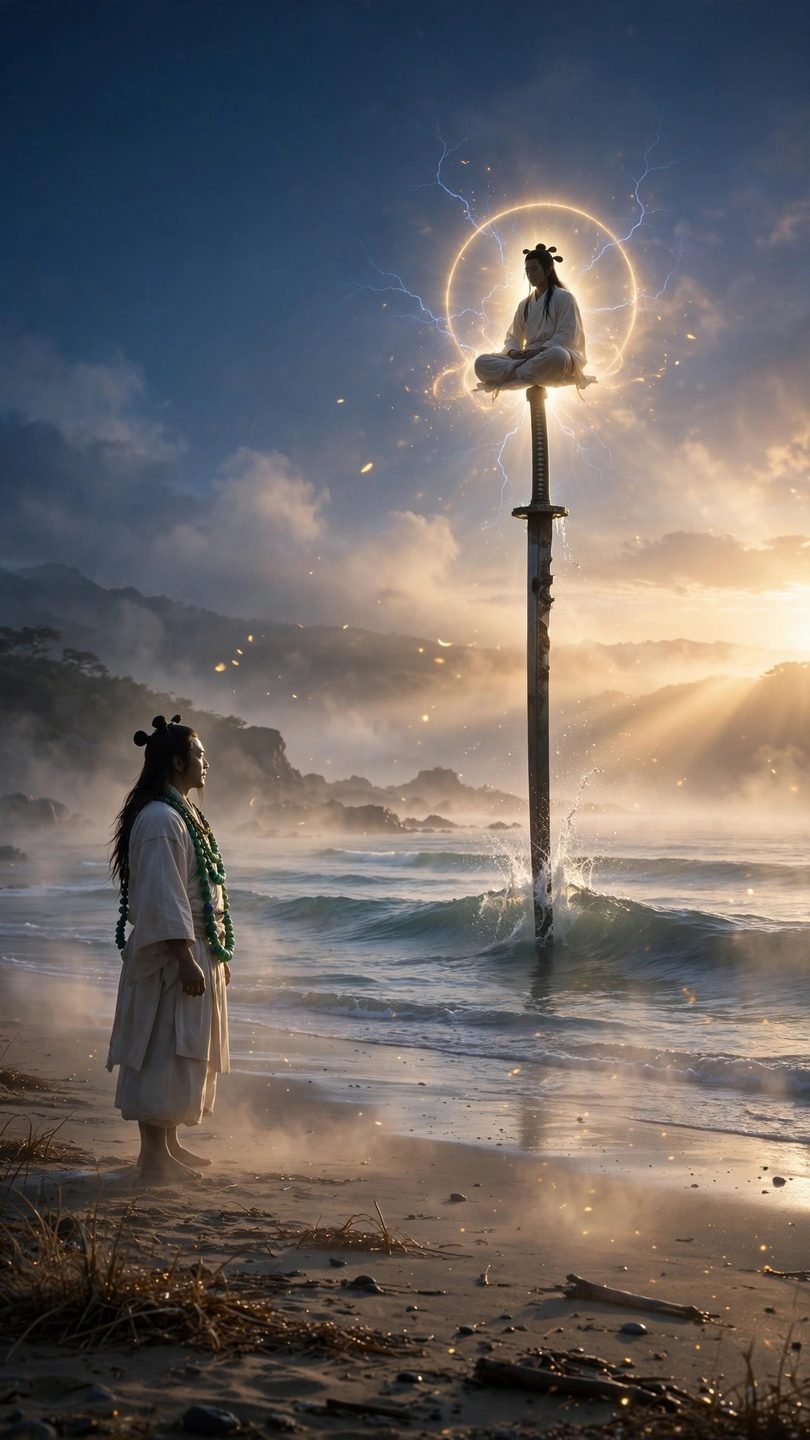
Takemikazuchi-no-Kami (建御雷神), sent from Takamanohara, pressed Ōkuninushi-no-Kami on the beach of 伊耶佐* in Izumo to cede the land. His son Kotoshironushi-no-Kami consented, and Takeminakata-no-Kami, who challenged Takemikazuchi to a trial of strength, was chased as far as the sea of Suwa (州羽海) in Shinano (科野) and surrendered. Ōkuninushi-no-Kami offered up the Central Land of the Reed Plains on condition that a magnificent dwelling be built for him, and Takemikazuchi-no-Kami reported that the land had been pacified.
The story
Takemikazuchi-no-Kami is sent
After the failure of Ame-no-Wakahiko, Amaterasu-Ōmikami again asked whom to send, and Omoikane-no-Kami and the other deities recommended 伊都之尾羽張神*, who dwelt in the Heavenly Rock Dwelling (天石屋) at the upper reaches of the Heavenly River Yasu (天安河), or his son Takemikazuchi-no-O-no-Kami (建御雷之男神). Because 伊都之尾羽張神 had dammed the waters of the Heavenly River Yasu and blocked the way, no other deity could go there, so Ame-no-Kaku-no-Kami (天迦久神) was sent as messenger. 伊都之尾羽張神 accepted the request and offered up his son Takemikazuchi-no-Kami. Thus Takemikazuchi-no-Kami was sent, with Ame-no-Torifune-no-Kami accompanying him.
The question at the small beach of 伊耶佐*
The two deities descended to the small beach of 伊耶佐* in the land of Izumo, drew a ten-fist sword (十掬剣), thrust it upside down into the crest of a wave, and sat cross-legged on the point of the sword. Then they asked Ōkuninushi-no-Kami: “We ask by command of Amaterasu-Ōmikami and 高木神*. The Central Land of the Reed Plains that you rule has been entrusted to our child as a land for him to rule. What is your mind?” Ōkuninushi-no-Kami answered that he could not answer himself; his son Yae-kotoshironushi-no-Kami (八重言代主神) should answer, but he had gone out to the cape of 御大* to catch birds and fish and had not yet returned.
The answer of Kotoshironushi-no-Kami
When Ame-no-Torifune-no-Kami summoned Kotoshironushi-no-Kami and questioned him, Kotoshironushi-no-Kami said to his father, “It is an awesome command. I will give this land to the child of the heavenly deities.” Then he trod on the boat he had come in to tip it over, clapped his hands in the reverse “heavenly” manner (天逆手), turned the boat into a fence of green brushwood (青柴垣), and hid inside it.
The trial of strength with Takeminakata-no-Kami
Asked whether he had any other son who should answer, Ōkuninushi-no-Kami named Takeminakata-no-Kami. Just then Takeminakata-no-Kami arrived, holding up on his fingertips a great rock that would take a thousand men to pull, challenged Takemikazuchi to a trial of strength, and seized Takemikazuchi-no-Kami's hand. At once Takemikazuchi-no-Kami's hand turned into an icicle and then into a sword blade, so Takeminakata-no-Kami drew back in fear. Next Takemikazuchi-no-Kami seized Takeminakata-no-Kami's hand like a young reed, crushed it, and flung him away, and Takeminakata-no-Kami fled. Takemikazuchi-no-Kami pursued him as far as the sea of Suwa (州羽海) in the land of Shinano (科野国), and when he was about to kill him, Takeminakata-no-Kami begged: “Do not kill me. I will not go out of this place, nor will I go against the words of my father or of Kotoshironushi-no-Kami. I will give up the Central Land of the Reed Plains as the child of the heavenly deities commands.”
The answer of Ōkuninushi-no-Kami and his dwelling
When Takemikazuchi-no-Kami returned and asked again, Ōkuninushi-no-Kami answered that it was as his two sons had said, that he too would not go against it, and that he would give up the Central Land of the Reed Plains. However, he stated that if his dwelling place were built like the palace where the child of the heavenly deities lives, with thick pillars set firmly on the bedrock deep in the earth and crossed roof-beams (氷木) soaring high enough to reach Takamanohara, he would withdraw into a far corner and serve. He also said that if Yae-kotoshironushi-no-Kami (八重事代主神) took the lead in serving, none of his many deity children would rebel.
The heavenly dwelling at 多芸志*
A heavenly dwelling (天之御舎) was built at the small beach of 多芸志* in the land of Izumo, and Kushiyatama-no-Kami (櫛八玉神), grandson of 水戸神*, served as cook and presented a heavenly feast. Kushiyatama-no-Kami became a cormorant, dived to the bottom of the sea, brought up clay in his beak, made many flat vessels, made a fire-drill from the stems of seaweed, and kindled fire. Then words of blessing were spoken: that this fire would blaze in Takamanohara until the soot hung long in the new palace of Kamumusubi (神産巣日御祖命), would bake hard the earth below down to the bedrock, and that a great sea bass caught by the fishermen would be cooked and presented. After that, Takemikazuchi-no-Kami returned to Takamanohara and reported that he had pacified the Central Land of the Reed Plains.
A plain retelling of what the original text of the Kojiki says (no published translation has been used). The subheadings were added for readability, using the words of the text.
Key points of this story
- Main textAs envoy for the ceding of the land, Takemikazuchi-no-Kami, son of 伊都之尾羽張神*, was sent with Ame-no-Torifune-no-Kami as his companion. The two deities stood a ten-fist sword (十掬剣) upside down on the crest of a wave on the small beach of 伊耶佐* in Izumo, sat on its point, and demanded that Ōkuninushi-no-Kami cede the land.
- Main textŌkuninushi-no-Kami left the answer to his son. Kotoshironushi-no-Kami consented, saying “I will give this land to the child of the heavenly deities,” then trod on his boat to tip it over, clapped his hands in the reverse “heavenly” manner (天逆手), and hid inside a fence of green brushwood (青柴垣).
- Main textTakeminakata-no-Kami challenged Takemikazuchi to a trial of strength, but Takemikazuchi-no-Kami's hand turned into an icicle and then into a sword blade, and he was no match. Driven as far as the sea of Suwa (州羽海) in the land of Shinano (科野国), he swore “I will not leave this place” and agreed to give up the land.
- Main textŌkuninushi-no-Kami offered up the Central Land of the Reed Plains on condition that a dwelling be built for him with thick pillars and high crossed roof-beams (氷木), like the palace of the child of the heavenly deities, and said that he himself would withdraw into hiding and serve. Thus Takemikazuchi-no-Kami reported that the land had been pacified.
- Compared with the Nihon ShokiIn the main text of the Nihon Shoki, section 9, the deities sent are the two deities Futsunushi-no-Kami (経津主神) and Takemikazuchi-no-Kami (武甕槌神), and no deity corresponding to Takeminakata-no-Kami appears. Ōanamuchi-no-Kami (大己貴神; that is, Ōkuninushi-no-Kami) gives the two deities the broad spear he used when he pacified the land, and withdraws into hiding.
- CommentaryAccording to the Kokugakuin University database of deity names, in the scene at the small beach of 多芸志*, the text does not make clear who built the heavenly dwelling (天之御舎) or who presented a feast to whom, so interpretations are divided: one view holds that the heavenly side entertained Ōkuninushi-no-Kami, another that Ōkuninushi-no-Kami made the offering to the heavenly deities, and so on. [source, Japanese]
Deities and people, and the shrines that enshrine them
- Amaterasu-Ōmikami天照大御神Enshrined at: Ise Jingū (Naikū, Inner Shrine), Atsuta Jingū, Kumano Hongū Taisha, Sumiyoshi Jinja (Hakata), Komagata Jinja, Hirota Jinja, Minashi Jinja, Hinomisaki Jinja, Izawa-no-Miya, Ōhirumemuchi Jinja, Kono Jinja, Kumano Nachi Taisha, Kamikawa Jinja, Mononobe Jinja, Nitta Jinja, Tamaki Jinja, 佐太神社
- Yagokoro-omoikane-no-Mikoto八意思兼命Enshrined at: Chichibu Jinja, Hinokuma Jingū and Kunikakasu Jingū
- Takamimusubi-no-Kami高御産巣日神Enshrined at: Hirota Jinja
- Takemikazuchi-no-Ōkami武甕槌大神Enshrined at: Kashima Jingū, Kasuga Taisha, Shiogama Jinja, Hiraoka Jinja
- Ame-no-Torifune-no-Kami天鳥船神Enshrined at: Ikisu Jinja
- Ōkuninushi-no-Ōkami大国主大神Enshrined at: Izumo Taisha, Hikawa Jinja (Ōmiya), Hokkaidō Jingū, Dewa Sanzan Jinja, Keta Taisha, Nikkō Futarasan Jinja, Hiyoshi Taisha, Tsushima Jinja, Toga Jinja, Takebe Taisha, Kanda Jinja (Kanda Myōjin), Minashi Jinja, Ōyamato Jinja, Taiheizan Miyoshi Jinja, Tsuno Jinja, Takase Jinja, Ōhirumemuchi Jinja, Kumano Nachi Taisha, Yaegaki Jinja, Ōkunitama Jinja, Kamikawa Jinja, Ōarai Isosaki Jinja, Okuni Jinja, Izumo Daijingū, Sakatsura-Isosaki Jinja, Ōgamiyama Jinja, Miho Jinja
- Kotoshironushi-no-Kami事代主神Enshrined at: Miho Jinja, Mishima Taisha, Suwa Taisha Shimosha (Harumiya and Akimiya), Utsunomiya Futaarayama Jinja, Shitori Jinja, 高鴨神社
- Takeminakata-no-Kami建御名方神Enshrined at: Suwa Taisha Kamisha Honmiya, Suwa Jinja (Nagasaki), Hirota Jinja, Suwa Taisha Shimosha (Harumiya and Akimiya), Shitori Jinja, Sumiyoshi Jinja (Shimonoseki), Kamikawa Jinja
- 伊都之尾羽張神*, also called Ame-no-Ohabari-no-Kami (天尾羽張神)Father of Takemikazuchi-no-Kami, dwelling in the Heavenly Rock Dwelling at the upper reaches of the Heavenly River Yasu. Asked to serve as envoy, he offered his son Takemikazuchi-no-Kami in his place.
- Ame-no-Kaku-no-Kami (天迦久神)Sent to ask the intentions of 伊都之尾羽張神*, who was blocking the way.
- Kushiyatama-no-Kami (櫛八玉神)Grandson of 水戸神*. At the small beach of 多芸志* he served as cook; becoming a cormorant, he made vessels from clay from the sea floor, kindled fire and presented a feast.
- Ten-fist sword (十掬釼)The sword that Takemikazuchi-no-Kami thrust upside down into the crest of a wave and sat upon its point.
- Fence of green brushwood (青柴垣)The fence into which Kotoshironushi-no-Kami turned his boat by clapping his hands in the reverse “heavenly” manner. Kotoshironushi-no-Kami hid inside it.
Select a deity's name to open its page in Shrine Note (names and scenes in the Kojiki and the Nihon Shoki).
How the Nihon Shoki differs
In the main text of section 9, Futsunushi-no-Kami (経津主神) is chosen first, Takemikazuchi-no-Kami (武甕槌神) steps forward to join him, and the two deities are sent together. In the Kojiki, Ame-no-Torifune-no-Kami accompanies Takemikazuchi-no-Kami (建御雷神), and Futsunushi-no-Kami does not appear.
故以即配經津主神、令平葦原中國In the main text of section 9, there is no trial of strength with Takeminakata-no-Kami; Ōanamuchi-no-Kami (大己貴神), accepting the words of Kotoshironushi-no-Kami, gives the two deities the broad spear he used when he pacified the land, and withdraws into hiding.
乃以平國時所杖之廣矛。授二神曰In variant account 2 of section 9, Takamimusubi-no-Mikoto (高皇産霊尊) commands that the affairs of the visible world be governed by the imperial grandson and that Ōanamuchi-no-Kami govern divine affairs, and promises to build the 天日隅宮* for him.
汝所治顯露之事。宜是吾孫治之。汝則可以治神事Reference
In the original text (4 passages)
拔十掬釼,逆刺立于浪穗,趺坐其釼前They drew a ten-fist sword, thrust it upside down into the crest of a wave, and sat cross-legged on the point of the sword.
恐之,此國者立奉天神之御子It is an awesome command. I will give this land to the child of the heavenly deities (the words of Kotoshironushi-no-Kami).
即取成立冰,亦取成釼刄(When Takeminakata-no-Kami seized his hand) Takemikazuchi-no-Kami's hand at once became an icicle, and then a sword blade.
僕者於百不足八十坰手隱而侍I will withdraw into a far, winding corner and serve (the words of Ōkuninushi-no-Kami).
Sources and what the labels mean
A small * after a name in kanji means that its reading could not be confirmed from the sources used here, so the name is left in its original characters.
"Main text" is what the Kojiki itself says; "Compared with the Nihon Shoki" is a difference checked in the original text of the Nihon Shoki; "Commentary" is an interpretation checked against a public institution's explanation. Quotations are copied character for character from the critical text on Chinese Wikisource (〔 〕 marks the original small notes). Names whose reading could not be confirmed are left in kanji. The pictures are all AI-generated illustrations, not depictions of actual sacred objects, shrine buildings or people.
- Kojiki, Part 1 (critical text) — Chinese Wikisource
- Nihon Shoki, Book 2 — Chinese Wikisource
- Kokugakuin University, Database of Deity Names (Japanese)
- Kokugakuin University, Database of Deity Names (Japanese)
- Kokugakuin University, Database of Deity Names (Japanese)
- Kokugakuin University, Database of Deity Names (Japanese)
- Kokugakuin University, Database of Deity Names (Japanese)