Kojiki, Part 1 · story 8 of 17
The Banishment of Susanoo-no-Mikoto and Yamata-no-Orochi
須佐之男命の追放と八俣遠呂智
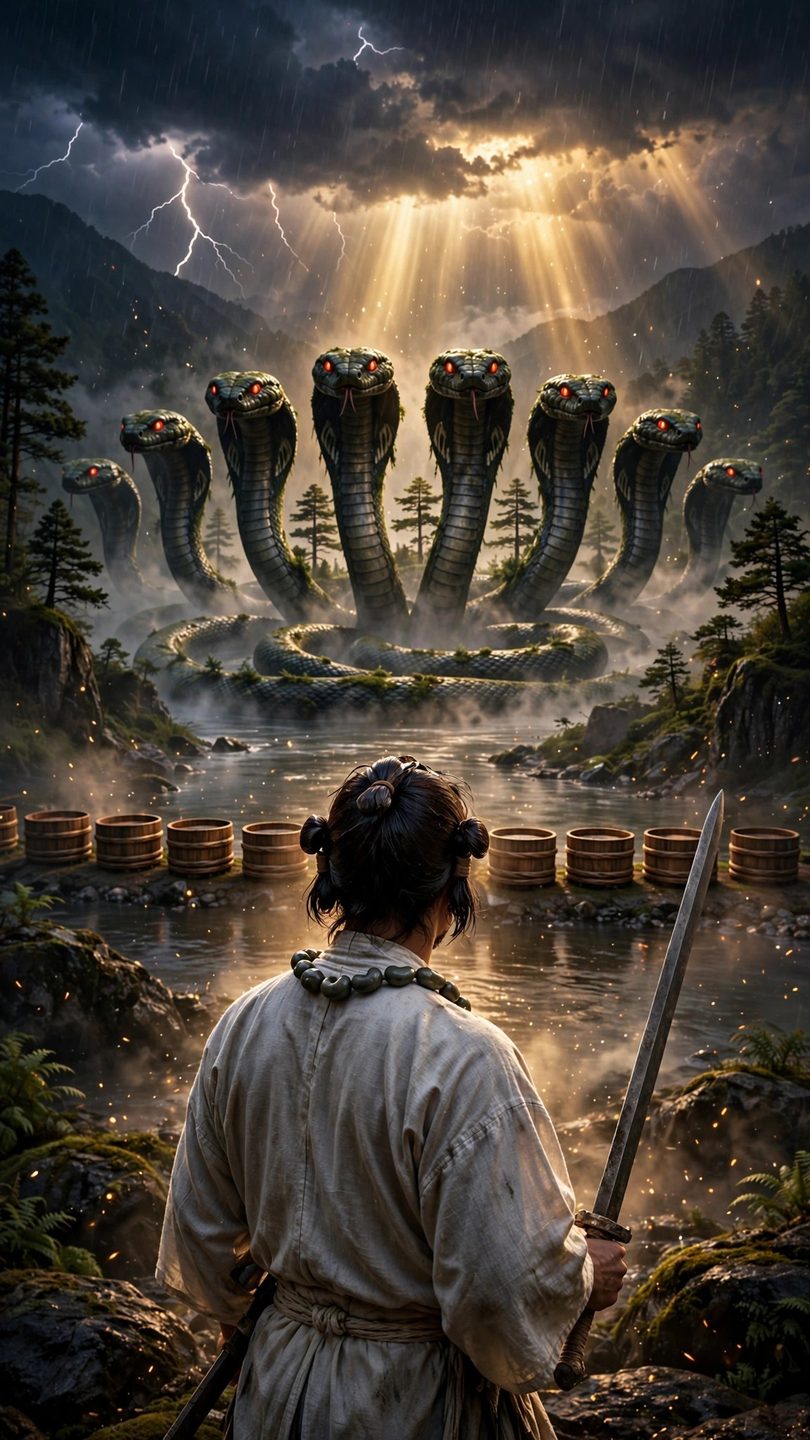
Driven out of the High Plain of Heaven (高天原), Susanoo-no-Mikoto met, in the upper reaches of the river 肥の河* in Izumo, an old couple weeping because their daughter was about to be eaten by Yamata-no-Orochi, and he made the great serpent drunk with sake and slew it. He presented to Amaterasu-Ōmikami the sword Kusanagi-no-Tachi, which came out of the serpent's tail, built a palace at 須賀* and lived there with 櫛名田比売*, and from their descendants Ōkuninushi-no-Kami (大国主神) was born.
The story
Banished from the High Plain of Heaven
The myriad deities (八百万の神々) consulted together, made Susanoo-no-Mikoto bear a great many articles of atonement (千位置戸), cut his hair (鬢) and the nails of his hands and feet, and drove him out of the High Plain of Heaven (高天原). Also, when food was asked of 大気都比売神*, she took various delicious things from her nose, mouth and buttocks, cooked them and offered them. Susanoo-no-Mikoto, peeping at what she was doing, thought that she was defiling the food before offering it, and killed 大気都比売神.
Seeds from the body of 大気都比売神*
From the body of the slain 大気都比売神* arose silkworms at the head, rice seeds in the two eyes, foxtail millet in the two ears, adzuki beans in the nose, wheat in the private parts, and soybeans in the buttocks. 神産巣日御祖命* had these taken and made them into seeds.
An aged couple weeping by the river 肥の河*
The banished Susanoo-no-Mikoto descended to a place called 鳥髪* in the upper reaches of the river 肥の河* in Izumo Province. Chopsticks came floating down the river, so, thinking there were people upstream, he went up and found an aged couple weeping with a girl between them. The husband named himself Ashinazuchi, an earthly deity (国つ神) and a child of Ōyamatsumi-no-Kami; the wife was Tenazuchi, and the daughter 櫛名田比売*. They said that the couple had originally had eight daughters, but the Yamata-no-Orochi of 高志* came every year and ate them, and now the time had come again this year, so they were weeping.
The appearance of Yamata-no-Orochi
As for the appearance of Yamata-no-Orochi, its eyes were red like akakagachi (according to a small note, what is now called 酸醤), and it had eight heads and eight tails on one body. Moss, cypress and cedar (檜, 榅) grew on its body, its length stretched across eight valleys and eight peaks, and its belly was always inflamed with blood.
Strong sake and eight gates
Susanoo-no-Mikoto announced that he was the younger brother of Amaterasu-Ōmikami (the original has 伊呂勢) and had just now come down from heaven, and so it was settled that he would receive the daughter. Susanoo-no-Mikoto turned 櫛名田比売* into a many-toothed comb (湯津爪櫛) and stuck it in his own hair, had the couple brew sake made strong by repeated brewing, had them build a fence around and make eight gates, and had them place at each gate a platform (佐受岐) and a sake vat, and wait. Yamata-no-Orochi came, put each of its eight heads into a sake vat and drank the sake, became drunk and fell asleep on the spot.
Cutting the serpent and Kusanagi-no-Tachi
Susanoo-no-Mikoto drew the ten-fist sword at his waist and cut the serpent to pieces, and the river 肥の河 flowed as blood. When he cut the middle tail the blade of his sword was chipped, so, wondering at this, he split the tail open with the tip of his sword and found the great sword 都牟羽の大刀* inside. Susanoo-no-Mikoto thought this an extraordinary thing and presented it to Amaterasu-Ōmikami. This is Kusanagi-no-Tachi.
The palace at 須賀* and the generations after
After that, Susanoo-no-Mikoto looked in Izumo Province for land on which to build a palace, and when he arrived at 須賀* he said, "Having come here, my heart is refreshed (sugasugashii)," and built a palace. Since clouds rose up at that time, he composed a song (the song is written in the original in man'yōgana, one character per syllable). Ashinazuchi was appointed head of this palace and given the name 稲田宮主須賀之八耳神*. Generation after generation followed from Yashimajinumi-no-Kami, the child of Susanoo-no-Mikoto and 櫛名田比売*, and Ōkuninushi-no-Kami was born as the child of Ame-no-Fuyukinu-no-Kami and Sashikuni-wakahime. Ōkuninushi-no-Kami also has the other names 大穴牟遅神, 葦原色許男神, 八千矛神 and 宇都志国玉神 (readings unconfirmed), five names in all.
A plain retelling of what the original text of the Kojiki says (no published translation has been used). The subheadings were added for readability, using the words of the text.
Key points of this story
- Main textSusanoo-no-Mikoto made Yamata-no-Orochi, which had eight heads and eight tails, drink strong sake, and when it was drunk and asleep he cut it to death with his ten-fist sword (十拳剣) and saved 櫛名田比売*.
- Main textWhen he cut the middle tail of the serpent, the blade of his sword was chipped, and a great sword was found inside the tail. Susanoo-no-Mikoto presented it to Amaterasu-Ōmikami, and this is Kusanagi-no-Tachi.
- Main textSusanoo-no-Mikoto was made by the myriad deities to bear a penalty, had his hair (鬢) and nails cut, and was banished from the High Plain of Heaven. Also, from the body of the slain 大気都比売神* arose silkworms, rice, foxtail millet, adzuki beans, wheat and soybeans, and 神産巣日御祖命* made these into seeds.
- Main textSusanoo-no-Mikoto built a palace at 須賀*, composed a song, and made Ashinazuchi the head of the palace. From the descendants of Susanoo-no-Mikoto and 櫛名田比売* is born Ōkuninushi-no-Kami, who has five names.
- Compared with the Nihon ShokiIn the main text of section 8 of the Nihon Shoki, the child born to Susanoo-no-Mikoto (素戔鳴尊) and 奇稲田姫* is regarded as Ōanamuchi (大己貴神), which differs from the genealogy of the Kojiki, which places Ōkuninushi-no-Kami as a descendant many generations later.
- CommentaryAccording to the Kokugakuin University database of deity names, besides being classified as a tale of the "Perseus-Andromeda type", in which a monster is defeated and a sacrificial maiden is saved, the story of Yamata-no-Orochi has also been viewed as a representation of the floods of the river 肥の河 (today's 斐伊川; readings unconfirmed), and there are views that connect the sword that came out of the tail with ironmaking and smithing in Izumo, among others. [source, Japanese]
Deities and people, and the shrines that enshrine them
- Susanoo-no-Mikoto須佐之男命Enshrined at: Hikawa Jinja (Ōmiya), Atsuta Jingū, Kumano Hongū Taisha, Tsushima Jinja, Tsurugi Jinja, Hinomisaki Jinja, Ōhirumemuchi Jinja, Kumano Nachi Taisha, Kumano Hayatama Taisha, Yaegaki Jinja, Ōgamiyama Jinja, Yasaka Jinja, 須佐神社, 佐太神社
- Ōgetsuhime-no-Ōkami大食都比売大神Enshrined at: Niutsuhime Jinja
- Amaterasu-Ōmikami天照大御神Enshrined at: Ise Jingū (Naikū, Inner Shrine), Atsuta Jingū, Kumano Hongū Taisha, Sumiyoshi Jinja (Hakata), Komagata Jinja, Hirota Jinja, Minashi Jinja, Hinomisaki Jinja, Izawa-no-Miya, Ōhirumemuchi Jinja, Kono Jinja, Kumano Nachi Taisha, Kamikawa Jinja, Mononobe Jinja, Nitta Jinja, Tamaki Jinja, 佐太神社
- Ōyamatsumi-no-Kami大山津見神Enshrined at: Dewa Sanzan Jinja, Ōyamazumi Jinja, Iwakiyama Jinja, Mishima Taisha, Kitaguchi Hongū Fuji Sengen Jinja, Ōyama Afuri Jinja, Ōgamiyama Jinja
- Inada-hime-no-Mikoto稲田姫命Enshrined at: Hikawa Jinja (Ōmiya), Yaegaki Jinja, Yasaka Jinja, 須佐神社
- Ōtoshi-no-Kami大年神Enshrined at: Minashi Jinja
- Ukanomitama-no-Kami宇迦之御魂神Enshrined at: Dewa Sanzan Jinja, Fushimi Inari Taisha, Kasama Inari Jinja, Yūtoku Inari Jinja, Ono Jinja, Futami Okitama Jinja
- Ame-no-Fuyukinu-no-Kami天之冬衣神No shrine in Shrine Note enshrines this deity yet.
- Sashikuni-wakahime刺国若比売No shrine in Shrine Note enshrines this deity yet.
- Ōkuninushi-no-Ōkami大国主大神Enshrined at: Izumo Taisha, Hikawa Jinja (Ōmiya), Hokkaidō Jingū, Dewa Sanzan Jinja, Keta Taisha, Nikkō Futarasan Jinja, Hiyoshi Taisha, Tsushima Jinja, Toga Jinja, Takebe Taisha, Kanda Jinja (Kanda Myōjin), Minashi Jinja, Ōyamato Jinja, Taiheizan Miyoshi Jinja, Tsuno Jinja, Takase Jinja, Ōhirumemuchi Jinja, Kumano Nachi Taisha, Yaegaki Jinja, Ōkunitama Jinja, Kamikawa Jinja, Ōarai Isosaki Jinja, Okuni Jinja, Izumo Daijingū, Sakatsura-Isosaki Jinja, Ōgamiyama Jinja, Miho Jinja
- Utsushikunitama-no-Kami顕國魂神Enshrined at: Iwakiyama Jinja
- Yamata-no-Orochi (八俣遠吕智)A great serpent with eight heads and eight tails that came every year and ate the daughters of Ashinazuchi and Tenazuchi; it is slain by Susanoo-no-Mikoto.
- Ashinazuchi (足名椎)An earthly deity (国つ神), a child of Ōyamatsumi-no-Kami, and the father of 櫛名田比売*. He is later made head of the palace at 須賀* and given the name 稲田宮主須賀之八耳神*.
- Tenazuchi (手名椎)The wife of Ashinazuchi and the mother of 櫛名田比売*.
- 神産巢日御祖命*The deity who had the things that arose from the body of the slain 大気都比売神* taken and made them into seeds (the database of deity names treats this as another name of Kamumusuhi-no-Kami).
- Kusanagi-no-Tachi (草那藝之大刀)The great sword that came out of the tail of Yamata-no-Orochi, which Susanoo-no-Mikoto presented to Amaterasu-Ōmikami.
- 十拳釼*The sword with which Susanoo-no-Mikoto cut Yamata-no-Orochi; its blade was chipped when it struck the great sword inside the tail.
- Yashimajinumi-no-Kami (八嶋士奴美神)The child of Susanoo-no-Mikoto and 櫛名田比売*, and the first deity in the genealogy leading to Ōkuninushi-no-Kami.
- Kamuōichi-hime (神大市比賣)A daughter of Ōyamatsumi-no-Kami, who with Susanoo-no-Mikoto gave birth to Ōtoshi-no-Kami and Ukanomitama-no-Kami.
Select a deity's name to open its page in Shrine Note (names and scenes in the Kojiki and the Nihon Shoki).
How the Nihon Shoki differs
In the main text of the Nihon Shoki, Ōanamuchi (大己貴神) is regarded as born directly as the child of Susanoo-no-Mikoto (素戔鳴尊) and 奇稲田姫*; it does not have a genealogy like that of the Kojiki, which reaches Ōkuninushi-no-Kami after many generations from Yashimajinumi-no-Kami.
乃相與遘合而生兒大己貴神The variant account in a small note attached to the main text of the Nihon Shoki gives the original name of the sword 草薙剣* as 天叢雲剣*, explains that this was perhaps because there were always clouds above the serpent, and relates that it was renamed 草薙剣 in the time of Prince Yamato Takeru (日本武皇子). This explanation is not in this section of the Kojiki.
本名天叢雲劒In variant account 2, the setting and plot differ from the Kojiki: for example, the place where Susanoo-no-Mikoto (素戔鳴尊) descended is given as the upper reaches of the river 可愛 in 安芸国 (readings unconfirmed), and the one about to be swallowed by the serpent is a child yet to be born.
下到於安藝國可愛之川上也Reference
In the original text (4 passages)
於頭生蠶,於二目生稻種(From the slain 大気都比売神)* silkworms arose at the head, and rice seeds in the two eyes.
其八俣遠吕智,信如言來,乃每船垂入己頭,飮其酒Yamata-no-Orochi truly came, just as had been said, put one of its heads into each sake vat, and drank the sake.
是者草那藝之大刀也This is Kusanagi-no-Tachi.
吾來此地,我御心須賀須賀斯Having come to this land, my heart is refreshed. (Told as the origin of the place name 須賀, reading unconfirmed.)
Sources and what the labels mean
A small * after a name in kanji means that its reading could not be confirmed from the sources used here, so the name is left in its original characters.
"Main text" is what the Kojiki itself says; "Compared with the Nihon Shoki" is a difference checked in the original text of the Nihon Shoki; "Commentary" is an interpretation checked against a public institution's explanation. Quotations are copied character for character from the critical text on Chinese Wikisource (〔 〕 marks the original small notes). Names whose reading could not be confirmed are left in kanji. The pictures are all AI-generated illustrations, not depictions of actual sacred objects, shrine buildings or people.
- Kojiki, Part 1 (critical text) — Chinese Wikisource
- Nihon Shoki, Book 1 — Chinese Wikisource
- Kokugakuin University, Database of Deity Names (Japanese)
- Kokugakuin University, Database of Deity Names (Japanese)
- Kokugakuin University, Database of Deity Names (Japanese)
- Kokugakuin University, Database of Deity Names (Japanese)
- Kokugakuin University, Database of Deity Names (Japanese)
- Kokugakuin University, Database of Deity Names (Japanese)
- Kokugakuin University, Database of Deity Names (Japanese)