Kojiki, Part 1 · story 7 of 17
The Heavenly Rock-Cave Door
天の岩屋戸
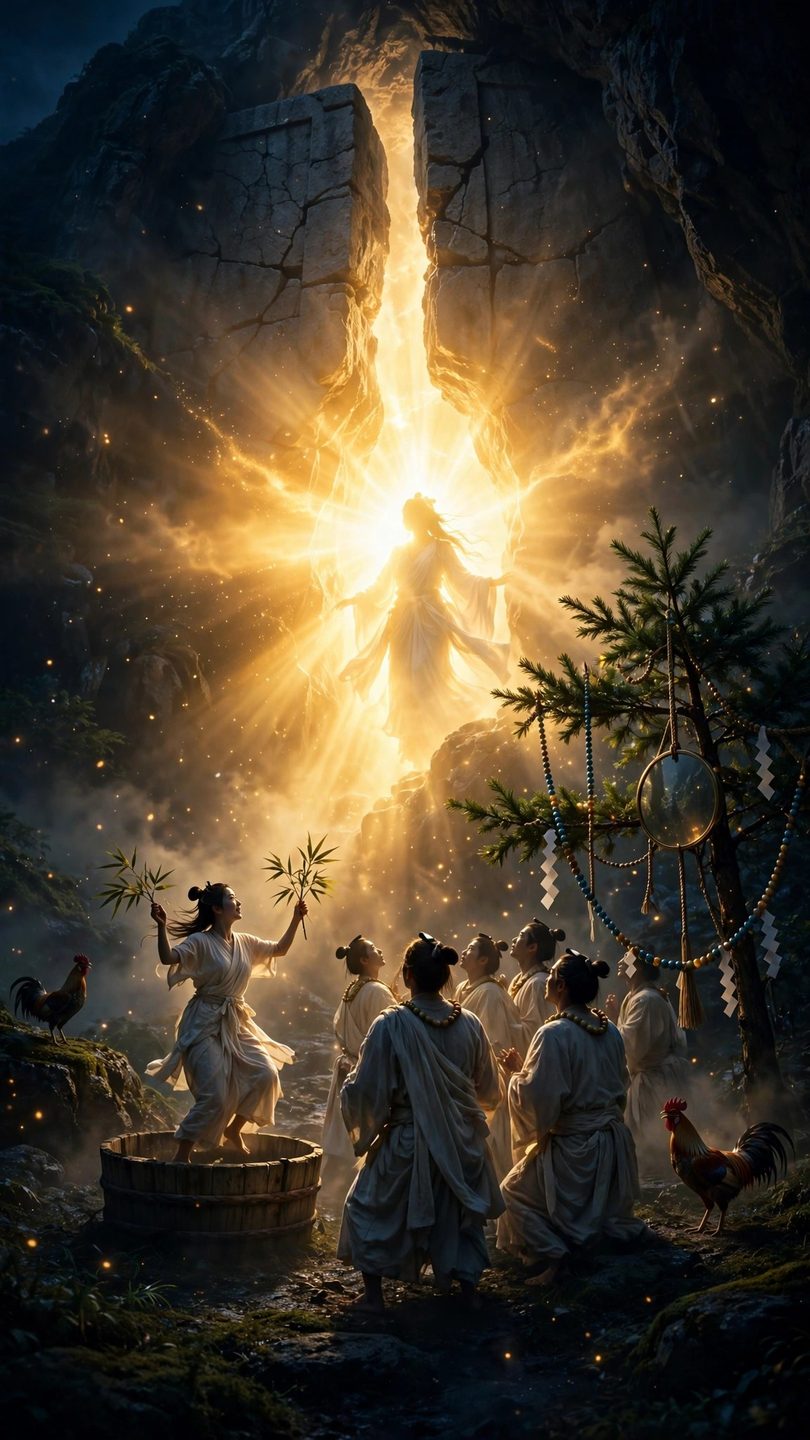
When Amaterasu-Ōmikami shut herself inside the Heavenly Rock-Cave Door (天石屋戸), both the High Plain of Heaven (高天原) and the Central Land of Reed Plains (葦原中国) grew dark, and all kinds of calamities arose. The myriad deities (八百万の神々) consulted together, gathered the implements for a ritual, lured Amaterasu-Ōmikami out with the dance of Ame-no-Uzume-no-Mikoto and the laughter of the deities, and restored light to the world.
The story
Amaterasu-Ōmikami closes the Heavenly Rock-Cave Door
Seeing the violence of Susanoo-no-Mikoto told in the previous story, Amaterasu-Ōmikami was afraid, closed the Heavenly Rock-Cave Door (天石屋戸), and shut herself inside. Then the High Plain of Heaven (高天原) became completely dark, the Central Land of Reed Plains (葦原中国) too was wrapped in darkness, and there was nothing but night. The voices of many deities filled the surroundings like swarms of flies, and every kind of calamity arose.
The deities' plan, the mirror and the jewels
So the myriad deities (八百万の神々) gathered at the riverbed of the heavenly river 天の安の河* and had Omoikane-no-Kami (思金神), a child of Takamimusubi-no-Kami, devise a plan. The deities gathered the long-crying birds of 常世* and made them cry, took hard stones from the upper reaches of the heavenly river 天の安の河 and iron from the heavenly metal mountain (天の金山), and sought out the smith Amatsumara. They had 伊斯許理度売命* make a mirror, and Tamanooya-no-Mikoto make strings of long curved jewels (八尺の勾玉).
Divination and the sakaki tree offering
Further, they summoned Ame-no-Koyane-no-Mikoto and Futodama-no-Mikoto (布刀玉命) and had them divine, pulling out the shoulder bone of a stag from 天香山* and using wood of the 波波迦* tree from 天香山. They dug up a sakaki tree (榊) of 天香山 by the roots, and hung the strings of jewels on its upper branches, the mirror 八尺鏡* on its middle branches, and white and blue cloth on its lower branches. Futodama-no-Mikoto held this up as an offering (御幣), Ame-no-Koyane-no-Mikoto recited a ritual prayer (祝詞), and Ame-no-Tajikarao-no-Kami stood hidden beside the door.
The dance of Ame-no-Uzume-no-Mikoto
Ame-no-Uzume-no-Mikoto hung the 日影 vine* of 天香山 across her shoulders as a sash, made a hair ornament of the 真拆 vine*, and held bundled bamboo-grass leaves in her hand. Then she turned a tub (汙氣) upside down in front of the Heavenly Rock-Cave Door and stamped on it until it resounded, became possessed by the deity, bared her breasts, and pushed the cord of her skirt down to her private parts. At this the myriad deities all laughed at once, so that the High Plain of Heaven rang with it.
Opening the door a crack
Amaterasu-Ōmikami wondered at this, opened the door a crack, and asked, "Since I have shut myself away, the world should be dark, so why is Ame-no-Uzume dancing so merrily and why are the deities laughing?" Ame-no-Uzume-no-Mikoto answered, "We are rejoicing and laughing because there is a deity here more noble than you." Meanwhile Ame-no-Koyane-no-Mikoto and Futodama-no-Mikoto held out the mirror and showed it to her, and Amaterasu-Ōmikami, wondering more and more, came out from the door little by little.
Amaterasu-Ōmikami is drawn out and the land becomes bright
At that moment Ame-no-Tajikarao-no-Kami, who had been standing hidden, took Amaterasu-Ōmikami by the hand and drew her out, and Futodama-no-Mikoto at once stretched a rope (尻久米縄)* across behind her and said, "You cannot go back inside beyond this." When Amaterasu-Ōmikami thus came out, both the High Plain of Heaven and the Central Land of Reed Plains became bright and illuminated of themselves.
A plain retelling of what the original text of the Kojiki says (no published translation has been used). The subheadings were added for readability, using the words of the text.
Key points of this story
- Main textWhen Amaterasu-Ōmikami closed the Heavenly Rock-Cave Door (天石屋戸) and shut herself in, both the High Plain of Heaven (高天原) and the Central Land of Reed Plains (葦原中国) became pitch dark, night went on and on, and every kind of calamity arose.
- Main textThe myriad deities gathered at the riverbed of the heavenly river 天の安の河*, had Omoikane-no-Kami (思金神) draw up a plan, had 伊斯許理度売命* make a mirror and Tamanooya-no-Mikoto make strings of curved jewels (勾玉), hung them on the branches of a sakaki tree (榊), and prayed.
- Main textWhen Ame-no-Uzume-no-Mikoto became possessed by the deity and danced before the door, the myriad deities laughed; they showed the mirror to Amaterasu-Ōmikami, who had opened the door wondering at this, and Ame-no-Tajikarao-no-Kami took her by the hand and drew her out, and so light returned to the world.
- Compared with the Nihon ShokiIn the main text of section 7 of the Nihon Shoki as well, the sequence is shared: the plan of Omoikane-no-Kami (思兼神), the prayers of Ame-no-Koyane-no-Mikoto (天児屋命) and Futodama-no-Mikoto (太玉命), the dance of Ame-no-Uzume-no-Mikoto (天鈿女命), and the drawing out by 手力雄神*. However, there is no scene in which a mirror is held out and shown to Amaterasu-Ōmikami (天照大神); instead, Amaterasu-Ōmikami herself opens the door a crack and peeps out, and 手力雄神 draws her out.
- CommentaryAccording to the Kokugakuin University database of deity names, regarding Ame-no-Uzume-no-Mikoto's act of baring her breasts and private parts, there are views such as that it aimed at the revival of nature through laughter, and that it relates to rites for pacifying the spirit (鎮魂), and in each of them its meaning as a rite for the revival of the sun deity is given great weight. [source, Japanese]
- CommentaryThe same database explains that the name of Omoikane-no-Kami (思金神) is often interpreted, from the Nihon Shoki spelling 思兼神, as a deity combining many kinds of thought, and that it is regarded as a deity that appears throughout the Kojiki and Nihon Shoki as an adviser to Amaterasu-Ōmikami. [source, Japanese]
Deities and people, and the shrines that enshrine them
- Amaterasu-Ōmikami天照大御神Enshrined at: Ise Jingū (Naikū, Inner Shrine), Atsuta Jingū, Kumano Hongū Taisha, Sumiyoshi Jinja (Hakata), Komagata Jinja, Hirota Jinja, Minashi Jinja, Hinomisaki Jinja, Izawa-no-Miya, Ōhirumemuchi Jinja, Kono Jinja, Kumano Nachi Taisha, Kamikawa Jinja, Mononobe Jinja, Nitta Jinja, Tamaki Jinja, 佐太神社
- Takamimusubi-no-Kami高御産巣日神Enshrined at: Hirota Jinja
- Yagokoro-omoikane-no-Mikoto八意思兼命Enshrined at: Chichibu Jinja, Hinokuma Jingū and Kunikakasu Jingū
- Ishikoridome-no-Mikoto石凝姥命Enshrined at: Hinokuma Jingū and Kunikakasu Jingū, Nakayama Jinja
- Tamanooya-no-Mikoto玉祖命Enshrined at: Hinokuma Jingū and Kunikakasu Jingū
- Ame-no-Koyane-no-Mikoto天児屋命Enshrined at: Kasuga Taisha, Hiraoka Jinja
- Ame-no-Futodama-no-Mikoto天太玉命Enshrined at: Awa Jinja, Ōasahiko Jinja
- Ame-no-Tajikarao-no-Kami天手力男神Enshrined at: Togakushi Jinja Okusha, Oyama Jinja
- Ame-no-Uzume-no-Mikoto天宇受売命Enshrined at: Tsubaki Ōkamiyashiro, Hinokuma Jingū and Kunikakasu Jingū, Yūtoku Inari Jinja, Ōhirumemuchi Jinja
- Amatsumara (天津麻羅)The smith (a metalworking craftsman) who was sought out to make the mirror.
- 常世長鳴鳥*The birds that were gathered and made to cry in order to call Amaterasu-Ōmikami out.
- 八尺勾𤥼之五百津之御須麻流之珠*The strings of curved jewels made by Tamanooya-no-Mikoto, hung on the upper branches of the sakaki tree.
- 八尺鏡*The mirror made by 伊斯許理度売命*, hung on the middle branches of the sakaki tree and held out to Amaterasu-Ōmikami (a reading note in the original says that 八尺 is read 八阿多).
- 天香山之五百津真賢木*The sakaki tree dug up by the roots from 天香山*, hung with jewels, mirror and cloth, and used in the ritual.
- 尻久米繩*The rope that Futodama-no-Mikoto stretched across behind Amaterasu-Ōmikami so that she could not go back into the rock cave.
Select a deity's name to open its page in Shrine Note (names and scenes in the Kojiki and the Nihon Shoki).
How the Nihon Shoki differs
The main text of the Nihon Shoki says that Ame-no-Uzume-no-Mikoto (天鈿女命) held in her hand a spear wound with reeds (茅) and performed skillfully as an entertainer (俳優, wazaogi) in front of the door of the heavenly rock cave (天石窟); this is depicted differently from the Kojiki's figure who becomes possessed with bamboo-grass leaves in her hand.
手持茅纒之矟In the main text of the Nihon Shoki, Amaterasu-Ōmikami (天照大神), hearing of Ame-no-Uzume-no-Mikoto's (天鈿女命) behavior, opens the door a crack with her own hand and peeps out, and at that point 手力雄神* draws her out; there is no scene, as in the Kojiki, in which a mirror is held out and shown to her.
乃以御手細開磐戶窺之Variant account 2 records that when the mirror was put into the rock cave it touched the door and received a small scratch, which still remains today, and states that this mirror is the great deity enshrined at Ise. This statement is not in the Kojiki.
觸戶小瑕Reference
In the original text (4 passages)
閇天石屋戶而,刺許母理〔此三字以音〕坐也She closed the Heavenly Rock-Cave Door and shut herself away inside.
高天原動而八百萬神共咲The myriad deities all laughed at once, so that the High Plain of Heaven rang with it.
益汝命而貴神坐,故歡喜咲樂(Ame-no-Uzume-no-Mikoto's answer) We are rejoicing, laughing and making merry because there is a deity here more noble than you.
高天原及葦原中國,自得照明Both the High Plain of Heaven and the Central Land of Reed Plains became bright and illuminated of themselves.
Sources and what the labels mean
A small * after a name in kanji means that its reading could not be confirmed from the sources used here, so the name is left in its original characters.
"Main text" is what the Kojiki itself says; "Compared with the Nihon Shoki" is a difference checked in the original text of the Nihon Shoki; "Commentary" is an interpretation checked against a public institution's explanation. Quotations are copied character for character from the critical text on Chinese Wikisource (〔 〕 marks the original small notes). Names whose reading could not be confirmed are left in kanji. The pictures are all AI-generated illustrations, not depictions of actual sacred objects, shrine buildings or people.