Kojiki, Part 1 · story 4 of 17
The Land of Yomi
黄泉の国
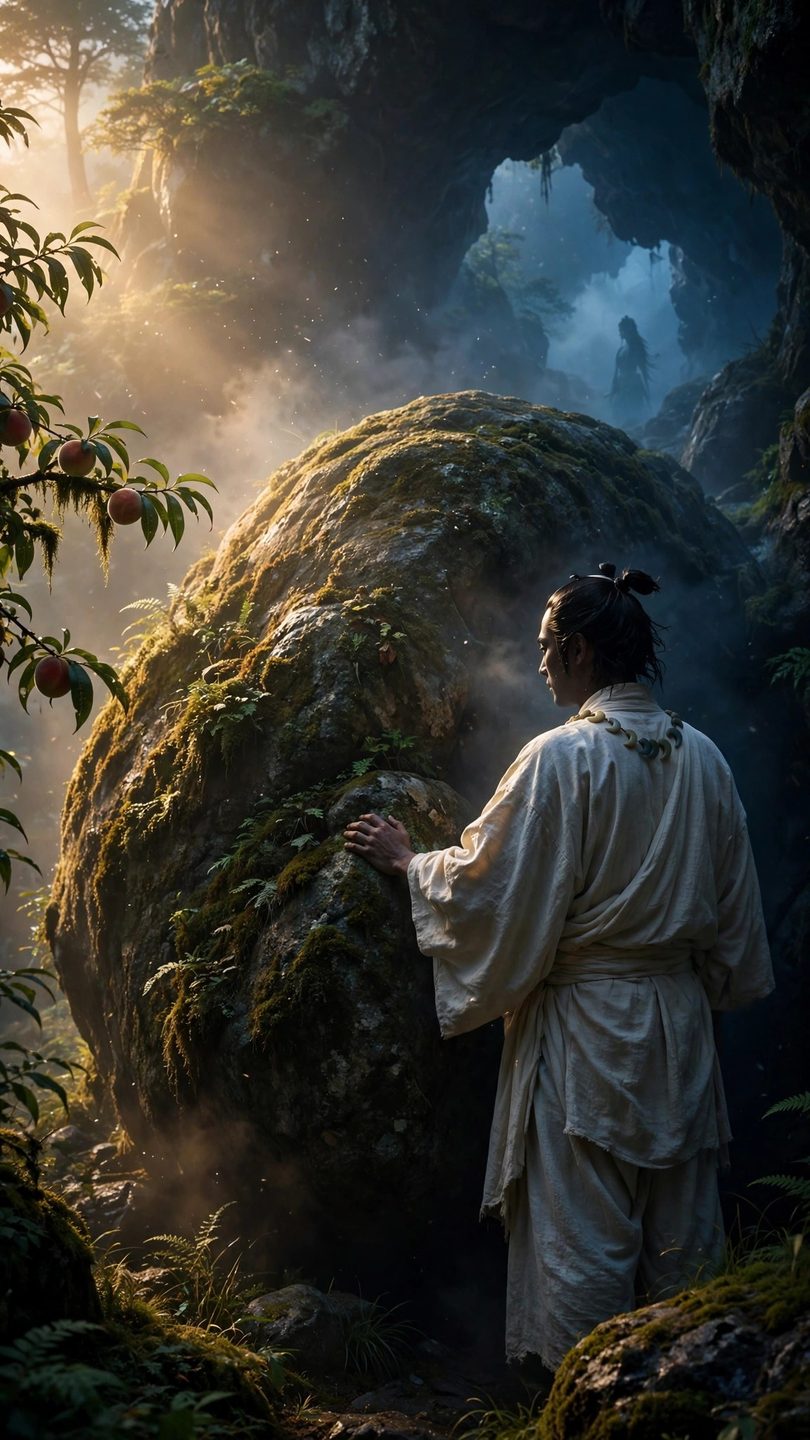
Izanagi-no-Mikoto goes to bring back his wife Izanami-no-Mikoto, who has gone to the Land of Yomi (黄泉国), but he breaks her plea "do not look at me", sees her utterly changed form, is pursued, and flees back. After blocking the slope 黄泉比良坂* with a rock and exchanging words of parting, Izanagi-no-Mikoto goes to perform purification (禊) to cleanse himself of defilement, and twelve deities are born from the belongings he throws off.
The story
Following Izanami-no-Mikoto to the Land of Yomi
Wishing to see his wife Izanami-no-Mikoto, Izanagi-no-Mikoto followed her to the Land of Yomi (黄泉国). When Izanami-no-Mikoto met him at the door of the palace, Izanagi-no-Mikoto called to her, "The land that the two of us have been making is not yet finished, so I want you to come back." Izanami-no-Mikoto replied, "I wish you had come sooner. I have already eaten the food of Yomi (黄泉戸喫)." Even so, she asked, "Since it is an awesome thing that you have come, I wish to return. I will go and talk for a while with the deities of Yomi, so please do not look at me in the meantime," and went back into the depths of the palace. Having been made to wait so very long, Izanagi-no-Mikoto broke off one of the thick end teeth of the comb he wore in the left loop of his hair (mizura), lit it, went in and looked. Maggots were swarming over Izanami-no-Mikoto's body, and on her head, chest, belly, private parts, left and right hands and left and right feet, eight thunder deities in all had arisen.
Izanagi-no-Mikoto flees from the pursuers
Izanagi-no-Mikoto was afraid and fled. Izanami-no-Mikoto said, "You have put me to shame," and had Yomotsu-shikome pursue him. When Izanagi-no-Mikoto threw away his black hair ornament, wild grapes (蒲子) sprang up, and he escaped while the pursuers picked them up and ate them; when he broke off the comb from the right loop of his hair and threw it, bamboo shoots sprang up, and while they pulled them up and ate them he escaped again. Next Izanami-no-Mikoto had the eight thunder deities pursue him with an army of fifteen hundred from Yomi, and Izanagi-no-Mikoto kept fleeing, swinging his ten-fist sword (十拳剣) behind him.
The peaches and the rock at 黄泉比良坂*
When he reached the foot of 黄泉比良坂*, Izanagi-no-Mikoto took three peaches that were there, waited, and struck at them, and the pursuers all fled back. Izanagi-no-Mikoto told the peaches, "Just as you have helped me, help the people living in the Central Land of Reed Plains (葦原中国) too when they meet with hardship and are troubled," and gave them the name Ōkamuzumi-no-Mikoto. Last of all, Izanami-no-Mikoto herself came in pursuit. Izanagi-no-Mikoto blocked 黄泉比良坂 with a rock that would take a thousand men to pull (千引石), and the two deities faced each other across the rock and exchanged words of parting. When Izanami-no-Mikoto said, "If you do this, I will strangle a thousand of the people of your land each day," Izanagi-no-Mikoto answered, "Then I will build fifteen hundred birthing huts each day." The Kojiki records that this is why, each day, a thousand people surely die and fifteen hundred are born.
Names given to the deities and the rock
Because of this, Izanami-no-Mikoto is called 黄泉津大神*, and because she caught up with Izanagi-no-Mikoto she is also called 道敷大神*. The rock that blocked the slope is called Chigaeshi-no-Ōkami (道反大神), and also 塞坐黄泉戸大神*. 黄泉比良坂 is said to be what is now 伊賦夜坂* in Izumo Province.
Going to perform purification
Izanagi-no-Ōkami said, "I have been to a terribly defiled land. So I will perform purification (禊) to cleanse my body," and went to 阿波岐原 at 小門 of 橘 in 日向 in 竺紫 (readings unconfirmed) and performed purification and exorcism (禊祓). From the staff, sash, skirt, robe, trousers and headdress, and the left and right armbands that he threw away there, twelve deities were born, from 衝立船戸神* to Hetsukaibera-no-Kami. The Kojiki explains these as deities born from his taking off the things he had been wearing.
A plain retelling of what the original text of the Kojiki says (no published translation has been used). The subheadings were added for readability, using the words of the text.
Key points of this story
- Main textIzanagi-no-Mikoto broke Izanami-no-Mikoto's request, "Do not look at me while I talk with the deities of Yomi (黄泉神)," lit a light and looked, and so came to be pursued by Izanami-no-Mikoto, who had been put to shame.
- Main textAfter 黄泉比良坂* was blocked with a rock that would take a thousand men to pull (千引石), Izanami-no-Mikoto said, "I will kill a thousand people a day," and Izanagi-no-Mikoto replied, "I will build fifteen hundred birthing huts a day." The Kojiki tells this as the origin of why, each day, a thousand people surely die and fifteen hundred are born.
- Main textIzanagi-no-Mikoto drove off his pursuers with three peaches from the foot of the slope, gave those peaches the name Ōkamuzumi-no-Mikoto, and commanded them to help the people of the Central Land of Reed Plains (葦原中国) too when they suffer.
- Compared with the Nihon ShokiIn variant account 9 of section 5 of the Nihon Shoki as well, Izanagi-no-Mikoto (伊弉諾尊) throws peaches and drives off the thunder deities, and this is explained as the origin of using peaches to ward off demons. On the other hand, peaches do not appear in variant account 6, which records a different tradition, that he urinated on a great tree and caused a great river to arise.
- CommentaryAccording to the Kokugakuin University database of deity names, regarding the rock that blocked the slope (Chigaeshi-no-Ōkami, 道反之大神), there is a view that sees 黄泉比良坂* as the boundary between this world and the world of the dead, and reads in the rock the character of a boundary deity, like the roadside deities (道祖神) or barrier deities (塞の神) that hold back the intrusion of evil things. [source, Japanese]
- CommentaryAccording to the same database, the way of escape in which hair ornaments and combs are thrown and the pursuers are held up by the food that springs from them is regarded as fitting the pattern of the "magic flight", which is found widely around the world. However, the final peaches drive off the pursuers by the power of the peaches themselves, and the influence of the idea, of Chinese origin, that peaches drive away demons has been pointed out. [source, Japanese]
Deities and people, and the shrines that enshrine them
- Izanagi-no-Mikoto伊邪那岐命Enshrined at: Shirayamahime Jinja, Izanagi Jingū, Taga Taisha, Oyama Jinja, Isasumi Jinja, Suwa Jinja (Nagasaki), Mitsumine Jinja, Kumano Nachi Taisha, Kumano Hayatama Taisha, Tamaki Jinja, Hikosan Jingū
- Izanami-no-Mikoto伊邪那美命Enshrined at: Kumano Hongū Taisha, Shirayamahime Jinja, Izanagi Jingū, Taga Taisha, Naminoue-gū, Isasumi Jinja, Suwa Jinja (Nagasaki), Ōhirumemuchi Jinja, Mitsumine Jinja, Kumano Nachi Taisha, Kumano Hayatama Taisha, Tamaki Jinja, Hikosan Jingū, 佐太神社
- Ōikazuchi-no-Kami大雷神Enshrined at: Ōyama Afuri Jinja
- Kunado-no-Kami久那斗神Enshrined at: Ikisu Jinja
- Yomotsu-kami (黃泉神)The deities of the Land of Yomi, with whom Izanami-no-Mikoto said she would go to consult about whether she might return.
- Yakusa-no-Ikazuchi-no-Kami (八雷神)The thunder deities that had arisen at eight places on Izanami-no-Mikoto's body. Given an army of fifteen hundred from Yomi, they pursued Izanagi-no-Mikoto.
- Yomotsu-shikome (豫母都志許賣)The first pursuer Izanami-no-Mikoto sent. Izanagi-no-Mikoto escaped from her while she was eating what sprang up from the hair ornament and comb he threw.
- Ōkamuzumi-no-Mikoto (意富加牟豆美命)The name Izanagi-no-Mikoto gave to the peaches that drove off the pursuers at the foot of 黄泉比良坂*.
- Chigaeshi-no-Ōkami (道反大神)The name given to the rock, which would take a thousand men to pull, that blocked 黄泉比良坂*. It is also called 塞坐黄泉戸大神*.
- Michi-no-Nagachiha-no-Kami (道之長乳齒神)A deity who came into being from the sash he threw away before the purification.
- 時置師神*A deity who came into being from the skirt he threw away (this is the spelling in this edited text; the database of deity names uses as its headword the spelling of another manuscript, 時量師神, and states that there are various views on the reading, so no reading is given).
- Wazurai-no-Ushi-no-Kami (和豆良比能宇斯能神)A deity who came into being from the robe he threw away.
- Chimata-no-Kami (道俣神)A deity who came into being from the trousers he threw away.
- Akigui-no-Ushi-no-Kami (飽咋之宇斯能神)A deity who came into being from the headdress he threw away.
- Okizakaru-no-Kami (奧疎神)The first of the three deities who came into being from the armband of the left hand that he threw away.
- Okitsunagisabiko-no-Kami (奧津那藝佐毗古神)The second of the three deities who came into being from the armband of the left hand.
- Okitsukaibera-no-Kami (奧津甲斐弁羅神)The third of the three deities who came into being from the armband of the left hand.
- Hezakaru-no-Kami (邊疎神)The first of the three deities who came into being from the armband of the right hand that he threw away.
- Hetsunagisabiko-no-Kami (邊津那藝佐毗古神)The second of the three deities who came into being from the armband of the right hand.
- Hetsukaibera-no-Kami (邊津甲斐弁羅神)The third of the three deities who came into being from the armband of the right hand.
Select a deity's name to open its page in Shrine Note (names and scenes in the Kojiki and the Nihon Shoki).
How the Nihon Shoki differs
In the scene where, in the Kojiki, Izanami-no-Mikoto says she "has already eaten the food of Yomi (黄泉戸喫)", Izanami-no-Mikoto (伊弉冉尊) in variant account 6 says, "I have already eaten food cooked in the hearth of the Spring (泉)." The pursuers are also given as eight Yomotsu-shikome (泉津醜女).
吾已飡泉之竈矣The Kojiki says that 黄泉比良坂 is 伊賦夜坂 in Izumo Province (readings unconfirmed), but variant account 6 states that 泉津平坂* is perhaps not a place that exists somewhere else, but refers to the time when one's breath fails as one faces death.
但臨死氣絕之際,是之謂歟In variant account 9, Izanagi-no-Mikoto (伊弉諾尊) hides beneath a great peach tree, throws its fruit at the thunder deities and makes them retreat, and this is explained as the origin of using peaches to ward off demons. Where the eight thunder deities are located also differs from the Kojiki: for example, the back and the buttocks, and a mountain thunder and a field thunder, appear.
此用桃避鬼之緣也Reference
In the original text (4 passages)
愛我那迩妹命,吾与汝所作之國,未作竟,故可還。My beloved wife, the land that you and I have been making is not yet finished. So I want you to come back.
且与黃泉神相論,莫視我。I will go and talk for a while with the deities of Yomi, so please do not look at me in the meantime.
吾一日立千五百産屋。(Then) I will build fifteen hundred birthing huts a day.
是以一日必千人死,一日必千五百人生也。This is why, each day, a thousand people surely die, and each day fifteen hundred people are surely born.
Sources and what the labels mean
A small * after a name in kanji means that its reading could not be confirmed from the sources used here, so the name is left in its original characters.
"Main text" is what the Kojiki itself says; "Compared with the Nihon Shoki" is a difference checked in the original text of the Nihon Shoki; "Commentary" is an interpretation checked against a public institution's explanation. Quotations are copied character for character from the critical text on Chinese Wikisource (〔 〕 marks the original small notes). Names whose reading could not be confirmed are left in kanji. The pictures are all AI-generated illustrations, not depictions of actual sacred objects, shrine buildings or people.
- Kojiki, Part 1 (critical text) — Chinese Wikisource
- Nihon Shoki, Book 1 — Chinese Wikisource
- Kokugakuin University, Database of Deity Names (Japanese)
- Kokugakuin University, Database of Deity Names (Japanese)
- Kokugakuin University, Database of Deity Names (Japanese)
- Kokugakuin University, Database of Deity Names (Japanese)
- Kokugakuin University, Database of Deity Names (Japanese)
- Kokugakuin University, Database of Deity Names (Japanese)
- Kokugakuin University, Database of Deity Names (Japanese)
- Kokugakuin University, Database of Deity Names (Japanese)
- Kokugakuin University, Database of Deity Names (Japanese)
- Kokugakuin University, Database of Deity Names (Japanese)
- Kokugakuin University, Database of Deity Names (Japanese)
- Kokugakuin University, Database of Deity Names (Japanese)
- Kokugakuin University, Database of Deity Names (Japanese)
- Kokugakuin University, Database of Deity Names (Japanese)
- Kokugakuin University, Database of Deity Names (Japanese)
- Kokugakuin University, Database of Deity Names (Japanese)
- Kokugakuin University, Database of Deity Names (Japanese)
- Kokugakuin University, Database of Deity Names (Japanese)
- Kokugakuin University, Database of Deity Names (Japanese)
- Kokugakuin University, Database of Deity Names (Japanese)
- Kokugakuin University, Database of Deity Names (Japanese)
- Kokugakuin University, Database of Deity Names (Japanese)
- Kokugakuin University, Database of Deity Names (Japanese)