Kojiki, Part 1 · story 2 of 17
The Birth of the Land
国生み
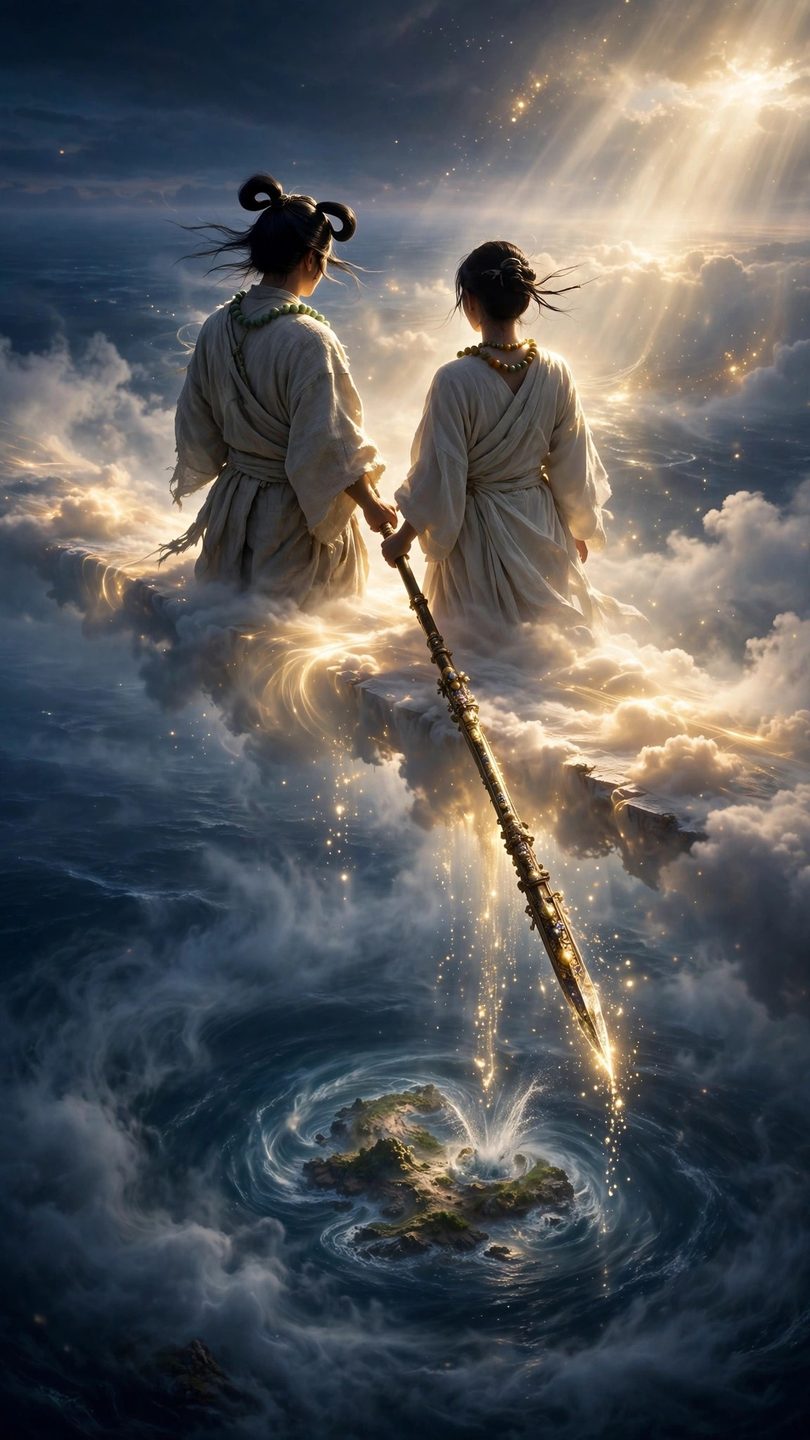
Receiving a command from the heavenly deities, Izanagi-no-Mikoto and Izanami-no-Mikoto made Onogoro-shima with the heavenly spear 天沼矛*, married there, and gave birth to the islands that became the land. Their first union did not go well because the female deity spoke first; after following the divination of the heavenly deities and starting over, the islands, beginning with the land 大八嶋国*, were born.
The story
The spear and Onogoro-shima
The heavenly deities commanded the two deities Izanagi-no-Mikoto and Izanami-no-Mikoto to put this drifting land in order and make it firm, and gave them the spear 天沼矛*. The two stood on the bridge 天浮橋*, lowered the spear, stirred the sea water until it made a sound, and drew it up. The brine that dripped from the tip of the spear piled up and became an island. This is Onogoro-shima.
Going around 天之御柱*
The two descended to that island and set up the pillar 天之御柱* and the hall 八尋殿*. When Izanagi-no-Mikoto asked how her body was formed, Izanami-no-Mikoto answered that "there is one place that did not grow together", and Izanagi-no-Mikoto said that he had "one place that grew in excess". Izanagi-no-Mikoto proposed that they join these and give birth to the land, and Izanami-no-Mikoto agreed. The two decided to go around 天之御柱 and meet, Izanami-no-Mikoto going around from the right and Izanagi-no-Mikoto from the left.
Izanami-no-Mikoto speaks first
When they met, Izanami-no-Mikoto first said, "Ah, what a fine young man!" and afterwards Izanagi-no-Mikoto said, "Ah, what a fine young woman!" (the original writes these words phonetically). Izanagi-no-Mikoto told her that "it was not good that the woman spoke first", but they united anyway, and the child born was Hiruko. This child was put in a reed boat and set adrift, and Awashima, born next, was not counted among their children either.
Divination by the heavenly deities
The two consulted together, went up to the heavenly deities and asked for instructions. The heavenly deities divined by the method 太占* and told them that it had not been good because the woman spoke first, so they should go down again and say the words over. The two descended again and went around 天之御柱 as before, and this time Izanagi-no-Mikoto called out first and Izanami-no-Mikoto afterwards.
The birth of eight islands
In this way the two united and gave birth to eight islands: Awaji-no-Ho-no-Sawake-no-shima, Iyo-no-Futana-no-shima, 隠伎之三子嶋*, Tsukushi-no-shima, 伊伎嶋*, 津嶋*, Sado-no-shima and Ōyamato-toyoakizu-shima. Iyo-no-Futana-no-shima and Tsukushi-no-shima each have one body and four faces, and each face has a name: 愛比売, 飯依比古, Ōgetsu-hime and 建依別; and 白日別, 豊日別, 建日向日豊久士比泥別 and 建日別 (readings unconfirmed). Because these eight islands were born first, the land is called 大八嶋国*.
Six more islands on the way back
After that, on their way back, they further gave birth to 吉備児嶋, 小豆嶋, 大嶋, 女嶋, 知訶嶋 and 両児嶋 (readings unconfirmed). These islands also each have another name: 建日方別, 大野手比売, 大多麻流別, 天一根, 天之忍男 and 天両屋 (readings unconfirmed). A small note counts the islands from 吉備児嶋 to 天両屋 together as six islands.
A plain retelling of what the original text of the Kojiki says (no published translation has been used). The subheadings were added for readability, using the words of the text.
Key points of this story
- Main textThe heavenly deities commanded Izanagi-no-Mikoto and Izanami-no-Mikoto to put the land in order and make it firm, and gave them the spear 天沼矛*. When the two stirred the sea with the spear from the bridge 天浮橋*, the brine that dripped from the tip of the spear piled up and Onogoro-shima was formed.
- Main textAt first, because Izanami-no-Mikoto spoke first, the child born, Hiruko, was set adrift in a reed boat, and Awashima was not counted among their children either. Through the heavenly deities' divination (太占) it became clear that this was "because the woman spoke first", and they started over with Izanagi-no-Mikoto speaking first.
- Main textAfter starting over, eight islands were born, from Awaji-no-Ho-no-Sawake-no-shima to Ōyamato-toyoakizu-shima, and because these were born first, the name 大八嶋国* arose. Then six more islands, including 吉備児嶋*, were also born.
- Compared with the Nihon ShokiIn the main text of the Nihon Shoki (section 4) there is no command from the heavenly deities; the two deities themselves say, "Surely there must be a land below," and probe with the spear. When the female deity calls out first, the male deity rebukes her on the spot and they start over, and there is no consultation with the heavenly deities or divination. The first island born is also different, 大日本豊秋津洲*, and 淡路洲* is called the "afterbirth" (胞).
- CommentaryAccording to the Kokugakuin University database of deity names, "Onogoro" is interpreted as meaning "to congeal by itself", and the name is said to indicate that it was an island that formed naturally, not one born from the marriage of the two deities. [source, Japanese]
- CommentaryAccording to the same database, views on the name "Hiruko" are divided between a view that it means, as the characters suggest, a child like a leech, and a view that the characters are phonetic substitutes for "日子" (child of the sun). In addition, since the statement that the child "could not stand on its legs even at three years old" is found only in section 5 of the Nihon Shoki, doubts have also been raised about applying it to the Hiruko of the Kojiki. [source, Japanese]
Deities and people, and the shrines that enshrine them
- Izanagi-no-Mikoto伊邪那岐命Enshrined at: Shirayamahime Jinja, Izanagi Jingū, Taga Taisha, Oyama Jinja, Isasumi Jinja, Suwa Jinja (Nagasaki), Mitsumine Jinja, Kumano Nachi Taisha, Kumano Hayatama Taisha, Tamaki Jinja, Hikosan Jingū
- Izanami-no-Mikoto伊邪那美命Enshrined at: Kumano Hongū Taisha, Shirayamahime Jinja, Izanagi Jingū, Taga Taisha, Naminoue-gū, Isasumi Jinja, Suwa Jinja (Nagasaki), Ōhirumemuchi Jinja, Mitsumine Jinja, Kumano Nachi Taisha, Kumano Hayatama Taisha, Tamaki Jinja, Hikosan Jingū, 佐太神社
- 天沼矛*The spear the heavenly deities gave to the two deities. With it they stirred the sea, and Onogoro-shima was formed.
- 天浮橋*The place where the two deities stood and lowered the spear.
- Onogoro-shima (淤能碁吕嶋)The island formed when the brine that dripped from the tip of the spear piled up. The place where the two deities descended and married.
- 天之御柱*The pillar set up on Onogoro-shima. The two deities went around it, met, and married.
- 八尋殿*The hall set up on Onogoro-shima together with the pillar 天之御柱.
- Hiruko (水蛭子)The child born from the first union. It was put in a reed boat and set adrift.
- Awashima (淡嶋)The island born after Hiruko. It was not counted among the children.
- Awaji-no-Ho-no-Sawake-no-shima (淡道之穗之狹別嶋)The first island born after the deities started over.
- Iyo-no-Futana-no-shima (伊豫之二名嶋)An island with one body and four faces. Each face has the name of a province.
- Tsukushi-no-shima (筑紫嶋)Like Iyo-no-Futana-no-shima, an island with one body and four faces.
- Sado-no-shima (佐度嶋)An island born as one of the islands of 大八嶋国*.
- Ōyamato-toyoakizu-shima (大倭豊秋津嶋)The eighth island born among the islands of 大八嶋国*. Its other name is 天御虚空豊秋津根別*.
- Ōgetsu-hime (大宜都比賣)The name of one of the four faces of Iyo-no-Futana-no-shima, that of the province 粟国*. It is regarded as a different deity with the same name as Ōgetsu-hime-no-Kami (大宜都比売神), who is born in the birth of the deities (database of deity names).
- 大八嶋國*The collective name for the eight islands that were born first.
Select a deity's name to open its page in Shrine Note (names and scenes in the Kojiki and the Nihon Shoki).
How the Nihon Shoki differs
In the main text of the Shoki there is no command from the heavenly deities; Izanagi-no-Mikoto (伊弉諾尊) and Izanami-no-Mikoto (伊弉冉尊) consult together on their own on the bridge 天浮橋*, probe with the spear 天之瓊矛*, and obtain Onogoro-shima (磤馭慮島). When they go around the pillar and the female deity calls out first, the male deity rebukes her on the spot and they start over; there is no consultation with the heavenly deities and no divination (太占).
底下豈無國歟The main text of the Shoki calls 淡路洲* the "afterbirth" (胞) and first gives birth to 大日本豊秋津洲*. 蛭児 and 淡洲 (readings unconfirmed) do not appear in the birth of the land in the main text, and islands such as 対馬 and 壱岐 (readings unconfirmed) are said to have formed from congealed sea foam.
先以淡路洲爲胞Variant account 1 is close to the Kojiki: the command of the heavenly deities, setting 蛭児* adrift in a reed boat, not counting 淡洲* among the children, and starting over through divination (太占). However, when they first go around the pillar the female deity goes left and the male deity right, and when they start over they also switch directions. In the Kojiki the female deity goes right and the male deity left from the start, and they go around the same way when they start over.
妹自左巡,吾當右巡Reference
In the original text (4 passages)
修理固成是多陀用幣流之國Put this drifting land in order and make it firm (the command of the heavenly deities).
自其矛末垂落塩之累積成嶋,是淤能碁吕嶋The brine that dripped from the tip of the spear piled up and became an island. This is Onogoro-shima.
女人先言不良It is not good that the woman spoke first (the words of Izanagi-no-Mikoto).
故因此八嶋先所生,謂大八嶋國。Because these eight islands were born first, the land is called 大八嶋国*.
Sources and what the labels mean
A small * after a name in kanji means that its reading could not be confirmed from the sources used here, so the name is left in its original characters.
"Main text" is what the Kojiki itself says; "Compared with the Nihon Shoki" is a difference checked in the original text of the Nihon Shoki; "Commentary" is an interpretation checked against a public institution's explanation. Quotations are copied character for character from the critical text on Chinese Wikisource (〔 〕 marks the original small notes). Names whose reading could not be confirmed are left in kanji. The pictures are all AI-generated illustrations, not depictions of actual sacred objects, shrine buildings or people.
- Kojiki, Part 1 (critical text) — Chinese Wikisource
- Nihon Shoki, Book 1 — Chinese Wikisource
- Kokugakuin University, Database of Deity Names (Japanese)
- Kokugakuin University, Database of Deity Names (Japanese)
- Kokugakuin University, Database of Deity Names (Japanese)
- Kokugakuin University, Database of Deity Names (Japanese)
- Kokugakuin University, Database of Deity Names (Japanese)
- Kokugakuin University, Database of Deity Names (Japanese)
- Kokugakuin University, Database of Deity Names (Japanese)
- Kokugakuin University, Database of Deity Names (Japanese)
- Kokugakuin University, Database of Deity Names (Japanese)
- Kokugakuin University, Database of Deity Names (Japanese)
- Kokugakuin University, Database of Deity Names (Japanese)